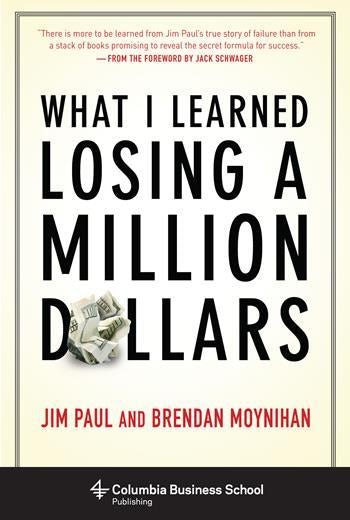
Author: Jim Paul & Brendan Moynihan
File under: Big Ideas, Learning, Philosophy
Executive Summary: What I Learned Losing a Million Dollars, charts the rise and fall of
self-confessed lucky man Jim Paul (1943–2001) from his early life as a farm boy in Kentucky to the Governor of the Chicago Mercantile Exchange by his mid-30’s. Jim recounts how his seemingly endless lucky streak came to an abrupt halt in a matter of months losing all of his money, his job and his title on a speculative bet.
The story of Jim’s life, while easy to follow, is not the main purpose of this book, and only serves to set the scene. Jim, now down-and-out seeks to understand where he went wrong, and recreate the magic of the life he once lived. To do this reads everything he can about investing and trading, and he comes to a shocking conclusion. Most successful traders made money in completely contradictory ways.
Feeling deflated, Jim instead trys asking the same question a different way. If successful people can make money in contradictory ways, how do they avoid going broke?
This is the key point – The secret to making money is not to lose money.
By avoiding the common traps that people are predisposed to stumble into. Jim realised that our emotional nature make it easy for us to get caught in investing traps, though assigning our own self-worth and self-image to our investments. This makes us more likely to double down on a losing investment, and fail to take profits out of winning ones – what Jim calls ‘crowd trades’.
‘Profitable trades’ that are missed actually cost zero, while poor controls (Pick your stop later) or no controls (no stop) will sooner or later cost you a lot of money.
Jim Paul – ‘What I learned losing a million dollars’
To avoid this trap, we need to find a way to decouple our emotional selves from our investing selves. For Jim, this means developing a plan; thinking through what you are going to do, what you think the market is going to do, how much you are willing to risk and making sure you understand the “why’s” to back up those decisions.
By slowing down your thinking and justifying your decision you distance yourself from your emotional feeling of loss or elation and can make smarter trades. While you may lose on some trades you won’t ever have a trade that wipes you out.
Overall, I really enjoyed this book and found the last third to be very helpful, both in thinking about investing, but also in everyday life. If you don’t have a plan, then you are just gambling.
B>llets:
- Its possible to be lucky many times in a row without realising it. You may attribute your achievements to skill but in reality it has just been luck.
- Jim views everything in live as a game – so to be successful in life, as in any game, you have to have a plan.
- There are many ways to make money in the markets, but all the really successful investors follow the same golden rule – first avoid losing money.
- Successful investors will establish a plan of how they are going to invest, how much they will lose (controlled using a stop-loss or options), and when they will get out.
- Trying to replicate the successes of others in areas outside of your expertise is difficult – best to stick to what you know and refine your process.
- It’s important to know the differences between an investor, a speculator, and a gambler, and to decide which you plan on being before you enter the market
- Investor: Making an informed investment in the market with a long time-horizon
- Speculator: Making an informed investment in the market with a shorter time-horizon
- Gambler: Making an investment in the market based on hearsay, emotion or following the crowd. Investing for enjoyment regardless of outcome.
- Follow the a decision making process – first decide what type of investor you want to be, then select a method of analysis that suits you, then develop rules, establish controls and finally create your plan
External Links:
Great Read for: Finance, Learning, Strategy
 Bvlletpoint
Leave a comment