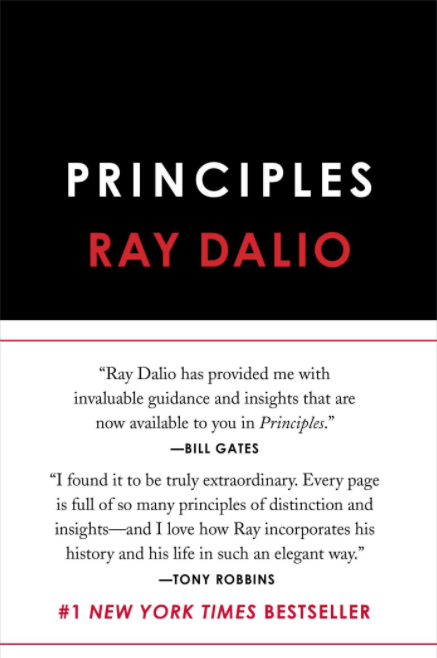
Author: Ray Dalio
File under: Learning, Strategy
Executive Summary: Ray Dalio grew Bridgewater Associates from a small two person operation in his bedroom one of the worlds premier fund managers. Rather than purely a narrative history, “Principles” focuses on the principles that he credits with his success in both life and business.
The book is broken up into three parts; A short narrative history, Ray’s Life Principles, and Ray’s Business Principles. It’s easy to read and while it touches on some complex subjects it does so in a clear and understandable way.
Each reader will find something different to take away from this book. As someone who is not the CEO of a large organisation, I found the most useful section to be ‘Life Principles’, as they were easily understood and I could take the lessons from here and make changes immediately.
Life principles is the longest secion of the book, but to me they generally revolved around some key themes:
- Taking action to achieve goals
- Taking radical responsibility
- Learning from mistakes & not tolerating “problems”
- Thinking in terms of second and third order consequences
Interestingly, many of the these ideas are repeated in some form or another in the later business focused chapters. Ray notes that this has lead many to suggest that Bridgewater is more akin to cult than business, but without having worked in the environment its hard to take a view on this (Ray, if you are reading this I’d love a job!).
The only issue I have with the book is that many of the business principles would be extremely hard to implement in an established organisation. For start-ups or small businesses, its potentially possible to replicate the Bridgewater model, but for large businesses its going to be quite difficult to move to a radically responsible and open culture.
Overall I found this to be a useful combination of a motivational handbook, life guidance and business textbook.
B>llets:
- Successful people are dynamic. They are constantly learning from their mistakes and adjusting their behaviour. The first step to this is taking radical responsibility for our actions and admitting where our weaknesses are.
- “The satisfaction of success does not come from achieving our goals, but from struggling well.”
- We should seek to understand problems and address the root causes as if we were fixing a machine.
- First document the process and understand how it should have worked
- Then identify what is causing the problem in the machine
- Address that component and re-test if it has resolved the issue. If not keep tuning the machine.
- However when seeking understanding we should be careful about where we get our information from. Opinions are everywhere but many people have no basis for their beliefs.
- “Believable opinions are most likely to come from people who 1) have successfully accomplished the thing three times, and 2) have great explanations for the cause-effect relationships that lead them to their conclusions.
- We should understand the second and third order consequences of our actions. First order consequences (“running makes me feel tired”) will cost us what we really want which are usually second (“running makes me fit and toned”) or third order consequences (“being fit will reduce my likelihood of health problems”).
External Links:
Great Read for: Startups, Growth, Learning, Strategy
 Bvlletpoint